Like most grandmothers, mine too had an immense influence on my life in many ways. Of late, amongst all her influences, the one I remember most is her views on food. I realize that many years before I studied nutrition or even thought about it in the way I do today, she lived and embodied it. Even after she retired from her hectic career, she remained constantly active both physically and mentally. She grew her own vegetables, was a beekeeper, and even made her own honey. Her food choices were guided not by trends but by wisdom or a rhythm of eating seasonally and were rooted in the land, not in a supermarket aisle.
This Diwali, as lights sparkle across cities and sweets fill every corner, I find myself thinking of a different kind of a feast, which is the Assamese thali. It’s not your typical festive indulgence, but an everyday celebration of balance, seasonality, and quiet nourishment.
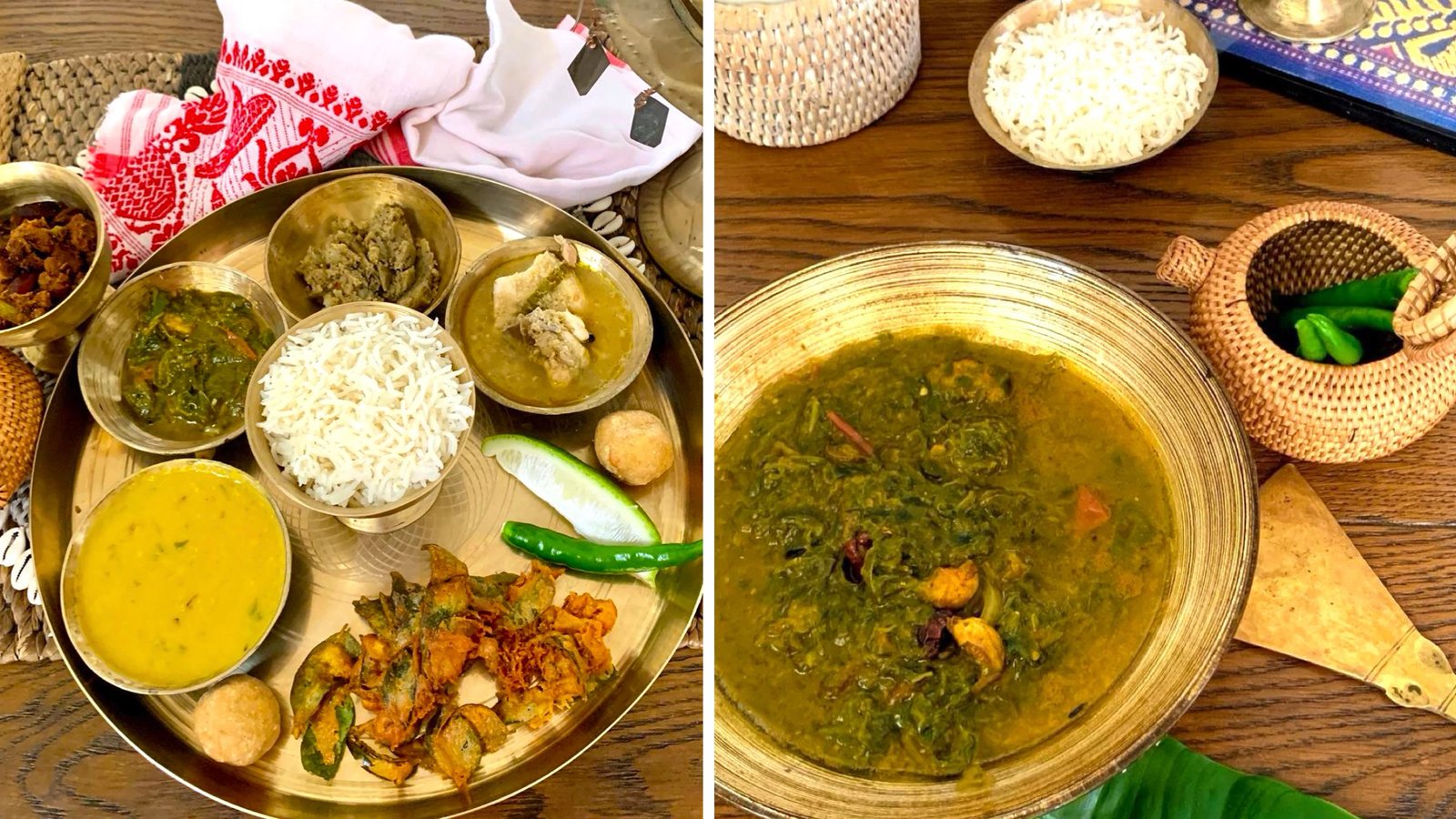
This isn’t just my grandmother’s thali. Every Assamese home, wealthy or humble, ate this way on beautiful plates of kansa (bell metal), which itself was believed to enhance immunity and improve digestion. Even the utensil reflected a philosophy, supporting local artisans, preserving village economies, and keeping communities in harmony. The food was steamed, roasted, or lightly stir-fried. Oils and spices were used sparingly. The hero of the Assamese plate was always the ingredient itself.
Typically Assamese meal starts with a preparation called KHAR. This is an alkaline dish made from the filtered ash of burnt banana peels, specifically the “Bheem Kol”, an indigenous wild banana, or even from water hyacinth. Scientifically, Khar is alkaline in nature, helping to neutralize excess gastric acid, aid digestion, and restore pH balance in the stomach, much like how modern nutritionists talk about gut alkalinity and detoxification. It can be made with raw papaya, pulses, bottle gourd, spinach, etc, and is said to gently detoxify the gut and prep it for digestion.
No Assamese meal is complete without greens or xaaks, as we call them. We eat a vast variety of wild and cultivated greens with lyrical names like laai xaak(mustard green) and dhekia xaak (fiddlehead fern). Nothing gets wasted, even the pumpkin, eggplant, and radish leaves are used as part of the meal.
During one of our Bihu celebrations, the arrival of spring, families traditionally ate 101 varieties of xaak. They rose early to forage from fields, riversides, and forests, bringing home bundles of greens, an act that was both culinary and ecological. These greens brought not just color but fibre, antioxidants, iron, calcium, and phytonutrients.
Then there are the pitikas, soft, mashed sides made from roasted vegetables, pulses, or seeds.
From roasted cherry tomatoes and Sweet potatoes to exotic jackfruit seeds or olives, each mashed with raw mustard oil, onions, and chillies.
Humble yet so comforting, and each one makes incredible dips – our own version of a mezze! The cold-pressed mustard oil is always drizzled raw on top, a bit like a wasabi topping, pungent but never overcooked.
A signature dish of the region, fish tenga is a tangy, soupy curry made with fresh river fish, tomatoes, lemon, or elephant apple. Designed perfectly for Assam’s humid climate, it’s cooling, anti-inflammatory, and rich in omega-3 fats. It’s our answer to both nourishment and climate, a functional food before such terms existed.
Two of Assam’s most distinctive ferments, khorisa(bamboo shoot) and panitenga (fermented mustard) are unique to the region. Khorisa, or fermented bamboo shoot, brings a tangy acidity rich in lactic acid bacteria that aids digestion and balances gut flora, while panitenga, the fermented mustard seed paste wrapped in banana leaf and cured naturally, transforms pungent mustard into an enzyme-rich, probiotic condiment.
Then there are small-batch fermented fish high in protein and preserved without refrigeration, and rice ferments like laopani, the traditional rice beer that once marked every community celebration, and of course, the humble poita-bhat, a leftover rice soaked overnight and eaten cold with mustard oil, onions, and chillies, is perhaps the simplest probiotic meal in Assam’s sultry summers.
In Assam, dessert was never the highlight, and perhaps that’s probably why metabolic disorders were rare.
Our sweet comfort came from nature, mainly seasonal fruits, rice, and black sesame pithas. Of course, there are varieties of ladoos and pithas, but none are overly decadent or sweet. Even our prasad in the namghar (temple) is not sugar or flour, but sprouted chana and green grams and seasonal fruits like banana, sugarcane, coconut, pomelo, etc
Why the Assamese Thali Still Stands Apart
Even now, I feel the Assamese cuisine has stayed largely untouched by culinary fads or too much post-colonial mimicry. Of course, we have lost many traditional greens and vegetables, but it has still remained close to its ecosystem i.e., a cuisine of rivers, forests, and fermentation.
In fact, Colleen Taylor Sen, a culinary historian, wrote in one of her books called Feasts and Fasts – A History of Food in India, that Assamese cuisine is the only regional Indian cuisine that has preserved the six tastes of ancient Hindu gastronomy. I could not agree more.
Across India, each region once had its own functional thali, maybe a system designed by geography, season, and microbiome. But somewhere, we all swapped that for uniformity. Our diets became heavier, oilier, and more homogenous, and our bodies respond with acidity, bloating, and fatigue.
The Assamese thali, to me, still carries something rare, as the memory of a time before influence, before excess, before confusion. It’s not perfect and may not be a king’s feast, but it’s real, rooted, and restorative.
This Diwali, as lights sparkle and homes overflow with sweets, I invite you to reflect on the food traditions of your own family and region. Which everyday recipes or practices, forgotten or alive, kept your ancestors healthy and connected to the land? Share your stories, recipes, or rituals, let’s celebrate not just the festival of lights, but the living wisdom on our plates.