
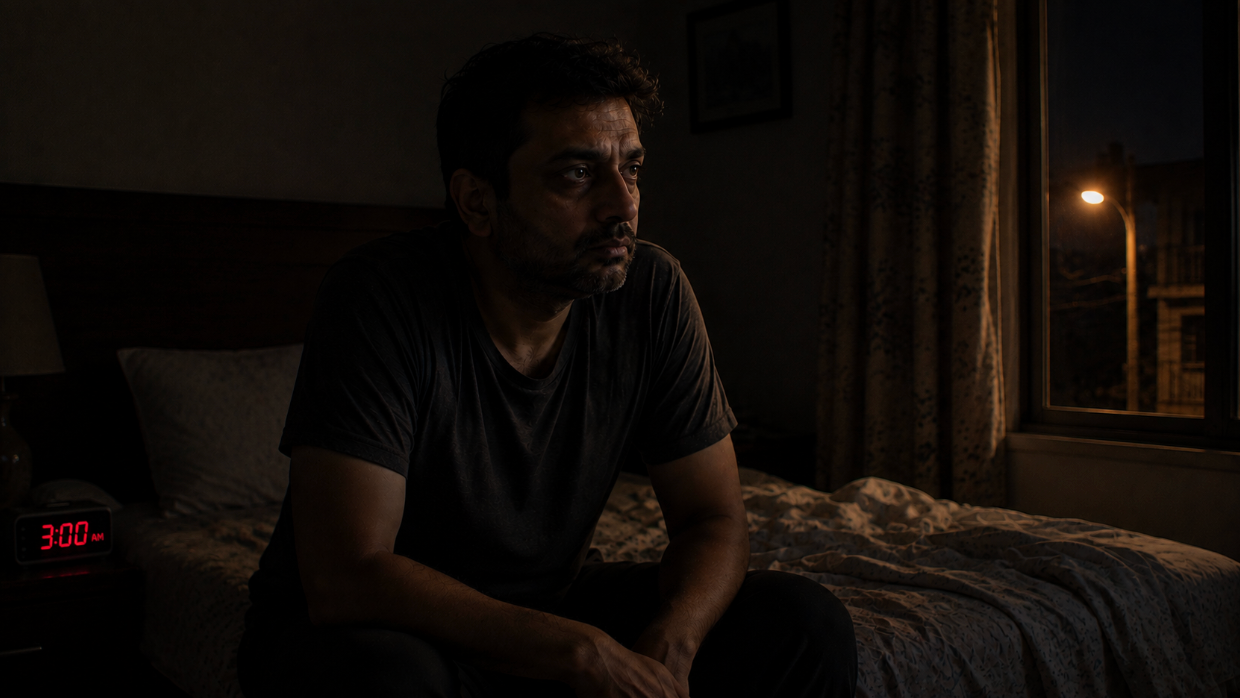
You don’t need months of poor sleep to affect your metabolic health. Clinical research shows that even a single night of restricted sleep can measurably reduce the body’s ability to handle glucose, creating a temporary state of insulin resistance.
A single night of limited sleep can cause a measurable reduction in how effectively your body responds to insulin. Researchers describe this as acute insulin resistance, and controlled studies have observed it after a single night of partial sleep deprivation.
Biological Cause:
Stress hormones such as cortisol, together with activation of the sympathetic nervous system, can interfere with the way muscles respond to insulin and take up glucose.
Actionable Plan:
You cannot replace lost sleep from a single night with supplements. However, next-day movement, sensible meal timing, and prioritizing a good recovery night may help support glucose regulation.
Long-term Effect:
Repeated episodes of inadequate sleep may contribute to chronic insulin resistance over time, particularly when combined with other metabolic risk factors.
Imagine waking up the night before a major business meeting, an overnight trip on a red-eye, or after bringing home a newborn baby. You go to bed at 10 pm; wake-up time is 2 am. The next morning, you may feel a little groggy but still able to function. You caffeinate and use the adrenaline from being awake so early in the morning to make it through the rest of the day. By nighttime, you feel mostly back to normal again.
What you likely didn’t notice was that your body’s ability to respond to insulin may already have changed.
Researchers studying sleep patterns have shown for decades that insulin resistance has often been viewed as a process that develops over time because of poor eating habits, excess weight, sedentary behavior, and other factors. This represents Medical Model 2.0 thinking – wait until the disease develops and then treat it based upon laboratory results.
However, a growing body of research into sleep and metabolism demonstrates how quickly changes can occur in blood sugar regulation. While years of poor lifestyle habits can contribute to impaired glucose regulation, researchers have also shown that a person’s ability to handle glucose can be significantly affected by acute sleep restriction.
This matters because most people have no concept that an individual episode of inadequate sleep can temporarily affect how their bodies manage glucose and insulin. Someone who experiences drowsiness throughout the day may attribute their lack of energy entirely to fatigue, without realizing that sleep and glucose metabolism are connected.
Medical Model 3.0, which views medicine through a preventative and personalized lens, presents a different question:
“Do you have diabetes?”
versus:
“How does your body currently regulate glucose in response to your daily lifestyle choices?”
This is where metabolic health becomes more than a diagnosis. It becomes an ongoing picture of how your body is responding to sleep, nutrition, movement, stress, and other factors.
If you want to understand the bigger picture, Longeny’s article [Your Weight Is Normal. Your Metabolic Health Isn’t.] explores why conventional measures such as weight and BMI may not always tell the full metabolic story.
In this article, you will learn what happens in your body after a night of reduced sleep, what clinical studies indicate about the speed and magnitude of this metabolic effect, and what steps you can take immediately and over the long term.
Think about insulin like an express delivery service. Muscle cells have all this glucose stacked up in them. Usually, insulin comes to the door and shows you its badge (or ID), and the door swings open, allowing glucose to enter the muscle cell so it can be used for energy.
This is what we mean when we talk about insulin sensitivity; or how effectively does the body respond when insulin delivers its signal?
When you limit your sleep, a different signal begins to influence the system. A period of disrupted or restricted sleep can increase stress-system activity, including cortisol and sympathetic nervous system activation.
These systems are useful when you need to stay alert. But when activated inappropriately or repeatedly, they can influence glucose regulation and make it harder for insulin to perform its normal role.
The badge is still valid; the door is just harder to open.
From a clinical perspective, the result can be that muscles take in less glucose per unit of insulin than they would have after a normal night’s sleep. The pancreas may respond by producing more insulin to help maintain glucose regulation. This compensatory response is one reason insulin levels can increase even when blood glucose does not appear dramatically abnormal.
You’re not necessarily chronically insulin resistant after one poor night. You may be temporarily less insulin sensitive.
And your body may have to work harder to achieve the same result.
This is different from the more complex insulin resistance that develops over years and involves factors affecting muscle, liver, adipose tissue, inflammation, and overall metabolism. Acute sleep-related changes can be faster and, in many cases, reversible with recovery.
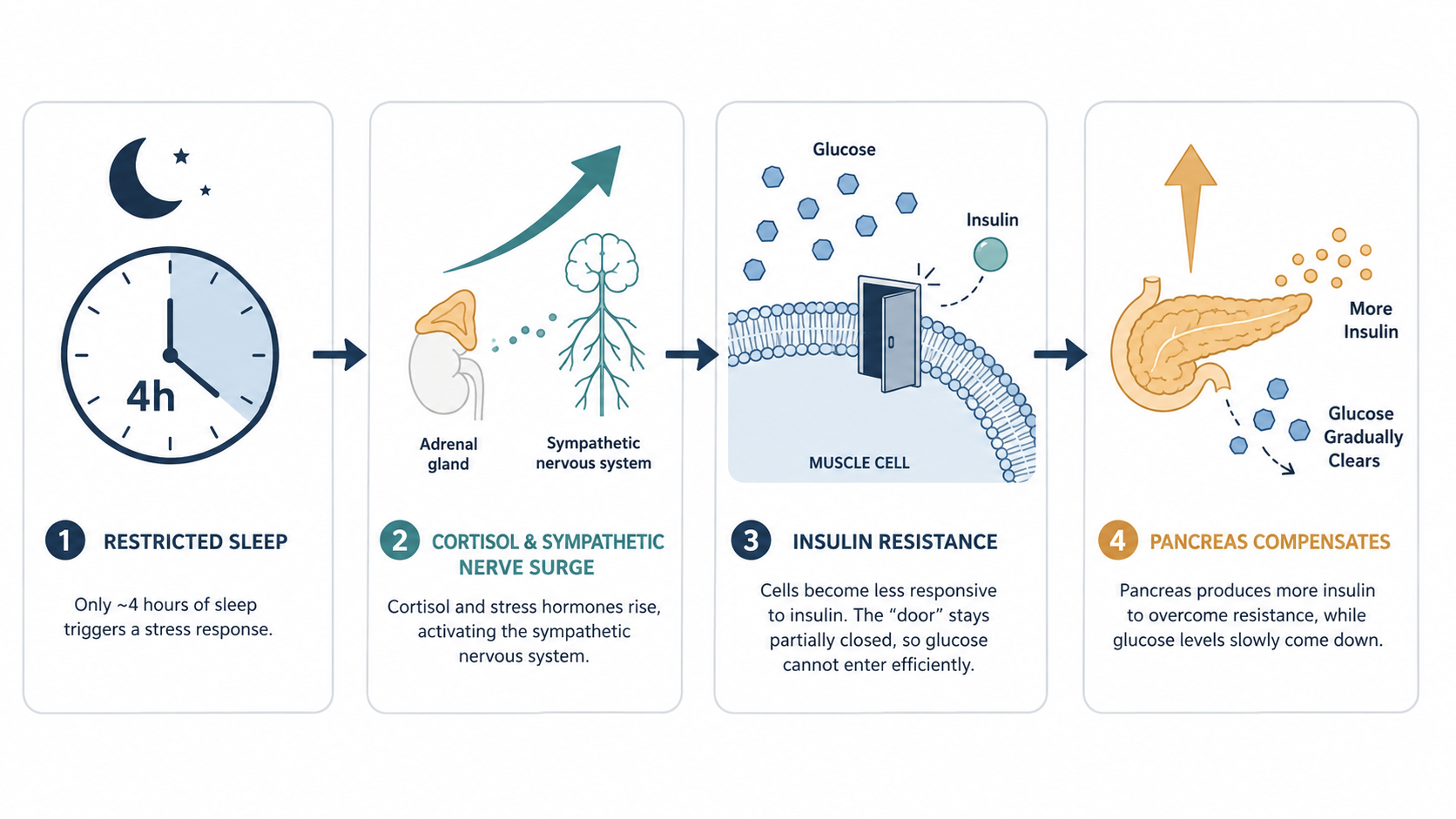 One night of poor sleep triggers a temporary hormonal blockade, not permanent damage, but a real, measurable one.[/caption]
The clearest evidence comes from controlled sleep-restriction trials rather than observational surveys.
In a randomized crossover study of 10 healthy young men, researchers compared two nights of habitual sleep with two nights during which sleep was restricted to 50% of the participants’ normal duration. After the restricted-sleep condition, the Matsuda Index, a commonly used measure of whole-body insulin sensitivity, was 18.6% lower. Insulin exposure during the glucose tolerance test was also higher.
Importantly, this study involved two nights of restricted sleep, rather than one. That distinction matters when interpreting the evidence.
Another controlled study investigated the effect of a single night of partial sleep deprivation. Nine healthy participants were studied after a normal night and after a night in which they were allowed only four hours of sleep. Using a hyperinsulinemic-euglycemic clamp, researchers found evidence of reduced insulin sensitivity after the restricted night.
These findings do not mean that one bad night permanently damages your metabolism.
They demonstrate something more useful: sleep can influence glucose regulation much faster than many people realize.
Longer studies involving repeated sleep restriction are more complicated. Some research suggests that the body can partially adapt to certain patterns of prolonged moderate sleep restriction. That does not mean inadequate sleep is harmless; it means the relationship between sleep duration, adaptation, insulin sensitivity, appetite, hormones, and metabolic risk is more complex than a simple linear equation.
To get an early sense of how you metabolize glucose, healthcare professionals may consider measures such as fasting glucose, fasting insulin, HOMA-IR, HbA1c, triglycerides, and other metabolic biomarkers, depending on the individual’s health profile.
A broader metabolic screening test may therefore provide more useful information than looking at a single glucose number in isolation.
Pillar | Intervention / Habit | Target Dosage / Frequency | Biomarker Tracked |
Movement | Brisk walk or light resistance session the morning after poor sleep | 20–30 min, within 2 hrs of waking | Post-meal glucose response |
Nutrition | Front-load protein and fiber at breakfast; delay high-refined-carb meals | First meal within 1–2 hrs of waking | Fasting insulin |
Sleep/Recovery | Prioritize one full, uninterrupted recovery night immediately after | 7–9 hrs, same-day fatigue permitting | Sleep duration/quality |
Diagnostics | Periodic fasting insulin + HOMA-IR check if poor sleep is frequent (2+ nights/week) | Every 3–6 months | HOMA-IR |
Movement can help. When muscles contract during physical activity, glucose uptake can increase through pathways that are not completely dependent on insulin signaling. This provides another reason why a short walk or light activity after a poor night’s sleep may be useful.
Prioritizing protein and fiber at your first meal can also help slow glucose absorption and reduce the size of the glucose challenge your body needs to manage.
These strategies are not substitutes for adequate sleep.
They are simply practical ways to support your body while it returns to normal.
Move within two hours of waking after a short-sleep night.
Walk, bike, lift, swim, or perform another form of comfortable movement. Even 15 minutes of walking is better than remaining inactive.
Front-load protein and fiber.
Build your first meal around protein, fiber-rich foods, and minimally processed carbohydrates rather than reaching automatically for a refined, high-sugar breakfast.
Prioritize the next night’s sleep.
The most important response to lost sleep is not another stimulant or supplement. It is giving your body an opportunity to recover.
Track one recovery metric.
For the next month, consider tracking sleep duration, fasting glucose, or another clinically appropriate measure. If you regularly experience poor sleep, discuss whether fasting insulin, HOMA-IR, or other metabolic biomarkers are appropriate for you.
If you are already using Longeny’s broader health assessment approach, remember that metabolic health does not exist in isolation. Hormones, gut health, genetics, nutrition, body composition, and lifestyle can all contribute to the bigger picture. Depending on the individual’s needs, this may include hormone testing, Genetic testing India, or gut-focused assessments such as a gut microbiome test India.
These tests should be selected based on clinical relevance rather than simply ordering every available test. Similarly, health test packages should be evaluated according to what they actually measure and whether those measurements answer a meaningful health question.
“Do I need a fasting insulin or HOMA-IR test since my sleep has been poor lately?”
“Is anything showing up in my blood work indicating that my insulin sensitivity may be changing?”
“Would additional metabolic biomarkers be useful based on my risk factors and symptoms?”
Your doctor can help determine whether testing is appropriate based on your age, medical history, medications, sleep pattern, family history, and existing metabolic risk factors.
Yes. Controlled studies show that even a single night of partial sleep deprivation can measurably reduce insulin sensitivity. This represents an acute metabolic response, not proof that one poor night has caused permanent insulin resistance.
The size of the effect depends on the study design and the degree of sleep restriction. In one study, two nights of sleep restricted to 50% of habitual sleep reduced the Matsuda Index by 18.6%.
A separate study found reduced insulin sensitivity after a single night in which participants were limited to four hours of sleep.
Acute sleep-related changes can improve when normal sleep is restored, but recovery varies between individuals and studies. It is better not to assume that every metabolic effect will disappear within exactly 24 hours.
The most reliable strategy is to restore consistent, adequate sleep rather than trying to compensate with supplements.
Light-to-moderate movement, such as walking, can support glucose uptake by working muscles. Pairing activity with a balanced meal containing protein and fiber may also help manage the glucose response.
These actions support recovery but do not replace adequate sleep.
Not necessarily.
Acute sleep restriction can produce a temporary reduction in insulin sensitivity, while chronic sleep disruption involves a much broader set of metabolic, hormonal, behavioral, and cardiovascular consequences.
The exact number of poor nights required to produce lasting metabolic changes has not been established.
There is no established threshold.
Research demonstrates measurable changes after acute sleep restriction, but it does not establish a precise number of disrupted nights per month that causes permanent insulin resistance.
That remains an important question for future research.
[1] Sweeney EL, Jeromson S, Hamilton DL, Brooks NE, Walshe IH. Skeletal muscle insulin signaling and whole-body glucose metabolism following acute sleep restriction in healthy males. Physiological Reports. 2017;5(23).
[2] Donga E, van Dijk M, van Dijk JG, et al. A single night of partial sleep deprivation induces insulin resistance in multiple metabolic pathways in healthy subjects.

Anil K.C. is the founder of LONGENY, a precision health platform focused on extending healthspan, and longevity, through science-backed diagnostics, nutrition, and personalized care. A serial entrepreneur and host of the Brighter100 podcast, he translates complex longevity science into clear, actionable insights.